










People often ask me how Quasar Expeditions began, eager to uncover the roots of our adventure-driven spirit. Few realize that the story traces back to a pivotal moment in 1969, when a chance encounter with the Galapagos Islands on a girl-only school field trip sparked a lifelong passion.
As a teenager in Quito, I was mesmerized by the tales of these remote islands, long before they became renowned. Little did I know, this early fascination with the Galapagos laid the groundwork for what would become Quasar Expeditions.
I love to think back about that transformative trip—after all, it was the origin of our unique approach to immersive travel. Let me take you back to those early days and share how my "girl vs wild" encounter with the Galapagos shaped the experiences we now offer.
Key Takeaways – Quasar’s Galapagos Origin Story
- Dolores Gangotena’s 1969 school trip sparked her lifelong connection with the Galapagos Islands.
- Her 15-day voyage revealed extraordinary wildlife, remote landscapes, and the islands’ transformative power.
- Galapagos protections now regulate visitor behavior to preserve wildlife and fragile ecosystems.
- Dolores’s early experiences inspired Quasar’s immersive approach to Galapagos travel and conservation.
The Beginning of a Lifelong Love Affair
In 1969, my biology teacher introduced me to the wonders of the Galapagos Islands. From that moment, I was captivated. The way she described the significance of the Islands for science and Ecuador sparked a deep sense of curiosity and a burning desire to visit. At that time, the Galapagos were not well-known, even within Ecuador. It was Charles Darwin’s Theory of Evolution that first brought the Islands into the spotlight for the scientific community.

An Unforgettable Journey Begins
Throughout that year, I couldn’t stop asking my biology teacher about the Galapagos. By spring, she had persuaded the school director to allow her to organize a 15-day cruise to the Islands. This was no easy feat, as there was no operating airport in the Galapagos back then, so the only way to reach the Islands was by navigating 600 miles from Guayaquil.
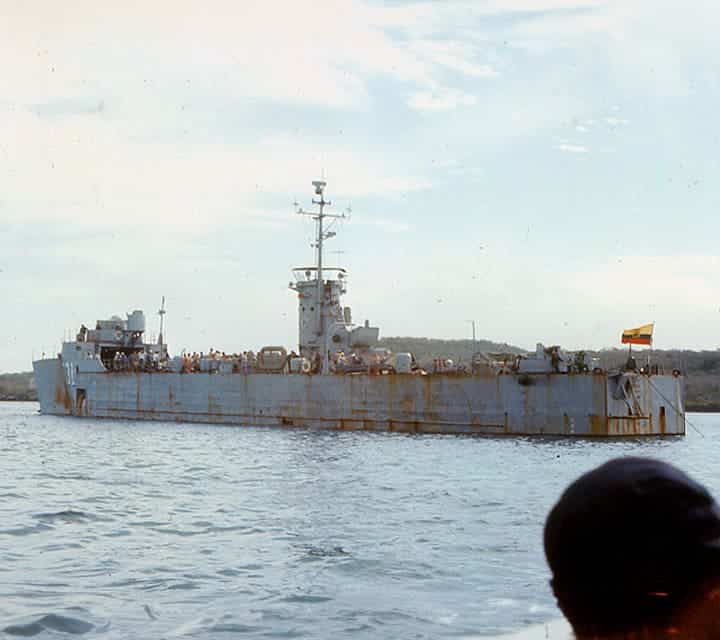
Given the lack of interest and awareness about the Islands, our only option was to join a Navy cargo vessel named Calicuchima, which transported supplies to the Islands for the approximately 3,000 inhabitants who lived in Galapagos back then. The Navy had allocated space for 12 tourists, housed in sailors’ cabins. Ultimately, there were eight of us, plus our teacher, ready for the adventure. The cost of the 15-day trip was 2,500 sucres per person, about $90 USD. (Shocking, I know!)
A Surprising Route to the Galapagos Islands
With the plan in place, our teacher had to convince our parents that the journey would be both safe and educational. After days of pleading, my parents finally granted me permission! I am forever grateful to them for their decision, as it would change my life.
In July 1969, we boarded a bus that would take us to Guayaquil, an eight-hour ride from Quito. We arrived at the dock around 5 PM, and our disappointment was palpable. The Calicuchima, which we had imagined as a grand ship like the Queen Elizabeth II, was instead a rusted metal cargo vessel with no sign of comfort. Our “cabins” turned out to be one shared cabin, which we had to share with our teacher. The ship’s hull was filled with cargo—flour, sugar, rice, and potatoes—leaving no empty space for anything else.

As soon as we settled into our cramped cabin (unpacking was impossible due to the lack of space), we decided to explore the boat. The only place we could find to relax was around a cannon that hadn’t been used in decades. It provided us with privacy from the crew and offered a view of the sea, which we found thrilling—at least at first. This enthusiasm waned a bit when we realized that the sea would be our only view for the next 3 days.
As many seamen grow accustomed to, we passed the time reading and counting the waves splashing against the rusted hull. Meals were far from what we had imagined, with lentils mixed with rice as our only source of protein. But when you’re 16, it’s just fine!
My First Glimpse of Darwin’s Paradise
By the end of the third day, we couldn’t believe our eyes—land! We rushed to the captain, who confirmed that it was indeed the Galapagos. We eagerly returned to our spot by the cannon, thrilled to watch our approach to San Cristobal Island. All we wanted was to set foot on land, but the captain informed us that we couldn’t disembark until the next day. As darkness fell, we waited, listening to the strange and unfamiliar sounds of the Islands—sea lions barking, fish splashing, and other mysterious noises from the water that we couldn’t yet identify.
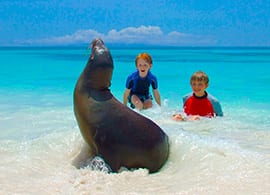
The next morning, we were ready by 5:30 AM to set foot on San Cristobal. The sailors lowered a wooden dinghy for us to board and take us to land. Halfway there, a sea lion unexpectedly jumped into our boat, causing panic. The sailors reassured us that the sea lions were friendly, and only then did I take a moment to appreciate the creature’s playful and endearing nature, much like a golden retriever.

Petting the sea lion pup, who was probably just a year old, made me realize that the barking we heard the night before had come from these fascinating animals. That experience ignited in me a profound love for the Galapagos and all its species. Many didn’t (and still don’t) have a reason to fear humans—a refreshing reminder of nature in its purest form.
- Guarantee The Perfect Adventure
- Avoid The Crowds
- Choose The Right Yacht For You
Awakening to the Colorful Wonders of the Galapagos
Disembarking in San Cristobal was nothing short of magical. The island was sparsely populated, with no more than five houses, and everywhere we looked, there was Galapagos wildlife — tame birds like mockingbirds and frigatebirds, sea lions, and giant tortoises. My eyes could hardly believe such beauty. We spent the entire morning walking around, soaking in the explanations from our teacher.
Around noon, we ventured into town—if you could even call it that—to find something to eat. A woman managing a small setup with two chairs offered to prepare lobster ceviche for 12 sucres (about $1). Thirty minutes later, we were served enormous portions of lobster, prepared so exquisitely that it tasted like heaven, especially after days of lentils. The afternoon was spent playing with sea lions and swimming in the crystal-clear waters. The day passed all too quickly, and by 5 PM, it was time to return to the ship.

The vivid encounters with the Galapagos—vibrant red Sally Lightfoot crabs scuttling along the shore, turquoise-footed boobies, and the piercing red eyes of marine iguanas—were like awakening to a full spectrum of color. It felt like stepping into a completely different world, far removed from bustling Quito.
A Lasting Connection with the Islands
We spent two more days in San Cristobal while the cargo was unloaded. Our next destination was Puerto Ayora on Santa Cruz Island. My love for the Galapagos only grew as we encountered marine and land iguanas, and a sea so clear that the underwater life was visible even from the shore.
No trip I had taken before this one had impacted me so profoundly. I couldn’t stop thinking about the beauty of this paradise, the tameness of its wildlife, and the richness of its waters.
In the following days, we visited James and Floreana Island, where I had the pleasure of meeting Mrs. Margret Wittmer, an amazing woman whose story is well told in her book, Floreana.

The days flew by, and before we knew it, the captain announced that it was time to head back to Guayaquil. It was at that moment that I made a promise to myself: no matter how or when, the Galapagos would always be part of my life. Once you’ve been there, these Islands are impossible to forget. In my case, the islands became part of my marriage and family life, and protecting the archipelago for future generations became my life’s most important work.
How Times Have Changed: Protecting the Galapagos Islands
It’s important to acknowledge that the Galapagos Islands have undergone significant changes since my first visit in 1969. You might recall my mention of petting a sea lion pup, which would not be permitted today—for critical reasons.
Back then, the Galapagos National Park had just been established, and there were no trails, guides, or regulations in place. We wandered freely, and interactions with wildlife, like touching the ancient shell of a Giant Tortoise or feeding oranges to the iguanas, were not uncommon.
Today, to protect the delicate ecosystem and preserve the pristine landscapes, the park has implemented strict guidelines. Visitors are now required to stay on clearly marked trails, be accompanied by a certified Galapagos National Park Guide, and maintain a distance of at least 6 feet (2 meters) from all wildlife.These measures ensure that future generations can experience the islands' natural beauty and wildlife in a manner that respects and protects this extraordinary environment.

Weaving Wonder into Our Galapagos Yacht Safaris
The wonder I felt on my first trip to the Galapagos is the foundation of our style of immersive travel at Quasar Expeditions. Our adventures are crafted to capture that childlike sense of awe and curiosity I experienced when I first set foot on the Islands. Every Quasar Galapagos luxury cruise is designed to embrace the full spectrum of the Galapagos—from intimate wildlife encounters to vibrant, unspoiled landscapes.
One unique trait of the Quasar traveler is the lasting connection they develop with the Galapagos. Just as I left a piece of my heart on those shores, our travelers come home with a deep appreciation for nature and a renewed sense of wonder for its remarkable beauty. Our goal is for every journey to leave an indelible mark, creating memories that resonate long after the adventure ends.


