

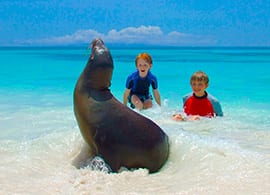
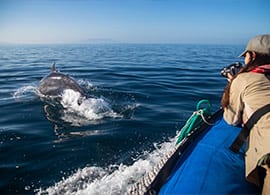









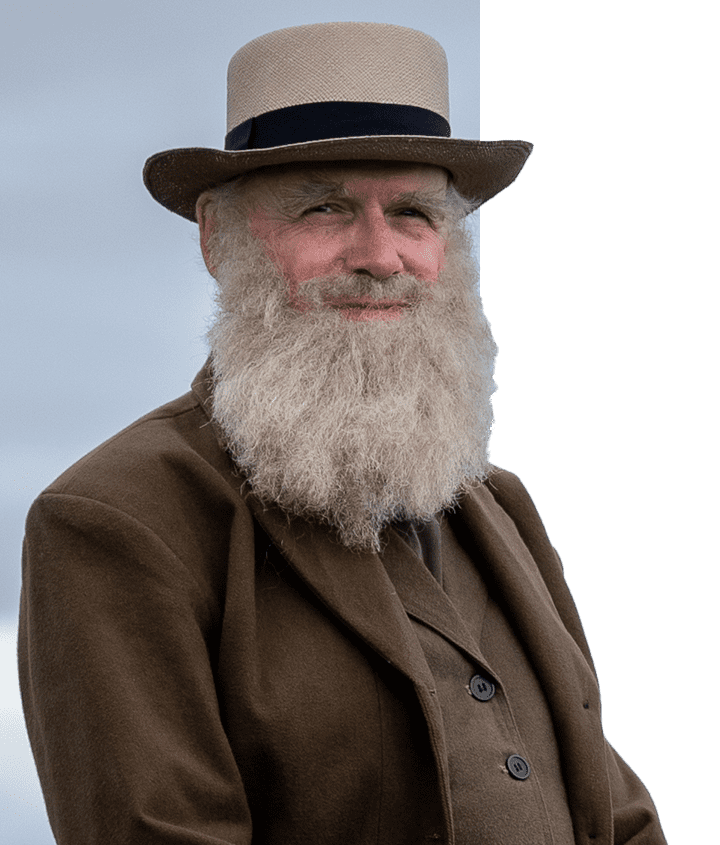
Imagine setting sail on a journey that would not only change your life but also alter the course of scientific thought forever. My name is Charles Darwin, and I embarked on such a voyage when I first visited the Galapagos Islands in 1835 during the journey of the HMS Beagle. You might wonder, what circumstances led me, a young naturalist, to join this remarkable expedition? The answer is a blend of chance encounters, influential mentors, and a touch of familial persuasion.
Key Takeaways – Charles Darwin and the Voyage of the Beagle
- Darwin joined the Beagle expedition after a recommendation from Cambridge professor John Stevens Henslow.
- The Beagle’s nearly five-year voyage exposed Darwin to extraordinary geological and biological diversity.
- Galapagos wildlife variations provided important insights that later influenced Darwin’s ideas about evolution.
- Darwin’s observations aboard the Beagle helped lay the groundwork for his theory of natural selection.
The Unexpected Opportunity
The opportunity to join the Beagle came quite unexpectedly. It all began when Captain Robert FitzRoy was seeking a companion for his upcoming voyage to chart the coast of South America and to determine longitudinal positions around the globe. FitzRoy wanted a young man of similar social standing and intellectual capacity to be able to enjoy conversations about different topics during the long months at sea.
At this point in my life, I was deeply fascinated by the natural world, thanks to the influence of John Stevens Henslow, a professor of botany at Cambridge. Henslow, impressed by my curiosity and dedication, recommended me for the position on the Beagle. However, my father was not thrilled about the situation. He viewed it as a distraction from my medical studies and a deviation from a respectable career path.
The Persuasive Uncle
After initially declining the offer, I sought the counsel of my uncle, Josiah Wedgwood. Understanding the potential of such an adventure, he encouraged me to seize the opportunity. Together, we convinced my father to reconsider. With reluctant approval from my father, I was free to embark on the voyage that would shape my future.
Setting Sail
We set sail in December 1831. The voyage was initially expected to last two years but extended to nearly five. My experiences in South America were nothing short of extraordinary. I was captivated by the diverse flora and fauna, making extensive collections and observations that would later become essential in the development of my theory of natural selection.

Download our detailed month-by-month guide to discover which animals you can see and what weather to expect.
DOWNLOAD THE GUIDE
The Galapagos Islands: A Turning Point
One of the most significant stops on our journey was the Galapagos Islands. The unique wildlife and the variations among species on different islands provided critical insights. I observed finches, later to be named Darwin Finches, with different beak shapes, each adapted to their specific environment. These observations were crucial in forming my ideas about adaptation and evolution.
“The archipelago is a little world within itself, or rather a satellite attached to America, whence it has derived a few stray colonists, and has received the general character of its indigenous population.”
- Quoted from Darwin's book: The Voyage of the "Beagle"

Facts about The Voyage of the Beagle
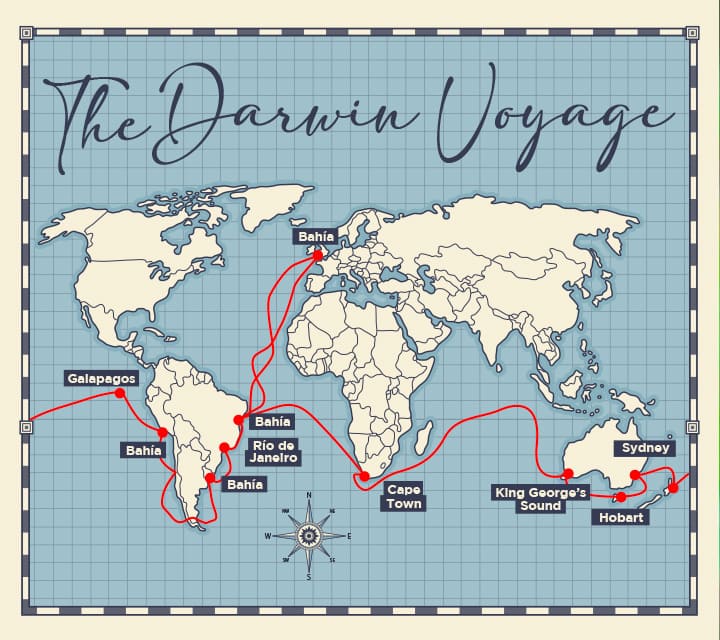
- Duration and Route: The Beagle's voyage lasted from December 1831 to October 1836, covering South America, the Galapagos Islands, Tahiti, New Zealand, Australia, and South Africa before returning to England.
- Primary Mission: The primary purpose was to chart the coast of South America and perform chronometric measurements to determine longitudinal positions.
- Significant Discoveries: The voyage led to significant geological and biological discoveries. Darwin collected fossils, studied volcanic islands, and noted the distribution of species, which influenced his later work.
- Impact on Science: The observations made during this voyage laid the groundwork for Darwin's theory of evolution by natural selection, which he published in 1859 in "On the Origin of Species".
- Ship and Crew: The HMS Beagle was a small warship of the British Navy. Captain FitzRoy, who was very careful and precise, was very important for the success of the ship's journey.
A Life-Changing Experience
Reflecting on my journey, it is clear that the voyage of the Beagle was a transformative experience. It broadened my horizons, deepened my understanding of the natural world, and set the stage for my future contributions to science. The Galapagos Islands, in particular, were a revelation. The unique biodiversity of the islands provided concrete examples of how species adapt to their environments over time.
Fate, Mentorship and Perseverance
In retrospect, joining the voyage of the Beagle was a combination of fate, mentorship, and perseverance. The journey was filled with challenges and discoveries that not only enriched my life but also revolutionized our understanding of biology. The Galapagos Islands remain a symbol of nature's adaptability and a testament to the enduring impact of exploration and scientific inquiry.
For those who yearn for adventure and a deeper connection with the natural world, the Galapagos Islands offer a timeless journey of discovery. Whether you're retracing the steps of a pioneering naturalist or carving out your own path, the spirit of exploration continues to thrive in these remarkable islands.
As a parting thought, remember that every great adventure begins with a single step—or in my case, a fateful invitation. Embrace the unknown, for it is in these moments that we find the keys to understanding our external and internal worlds.
