











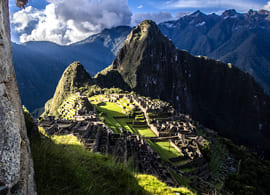






Machu Picchu has long captivated travelers with its remarkable history and mystical mountain setting. But as you’re planning a trip to this wonder of the world, the logistics can feel like an obstacle that stands in the way of your bucket-list adventure. How do you actually get to this remote Incan citadel? What’s the closest airport? And how does this leg of the journey fit into a broader Peru adventure?
The simplest answer is this: Machu Picchu does not have an airport of its own. That means most travelers fly into Lima first, then connect to Cusco, and from there continue by road and train toward the citadel. On a thoughtfully designed journey with Quasar, those transitions don’t feel like obstacles. They become important chapters of the greater story, allowing Peru to unfold in a way that feels intuitive and full of magic.
Key Takeaways – Flying to Machu Picchu & Peru
- Machu Picchu has no airport, so travelers typically reach the region through Cusco.
- Most international travelers enter Peru through Lima before connecting onward to Cusco.
- From Cusco, travelers continue through the Sacred Valley and by train toward Machu Picchu.
- Planning flights, trains, transfers, and entry tickets together makes the journey considerably easier.
What Airport Do You Fly Into for Machu Picchu?
Cusco’s Alejandro Velasco Astete International Airport (CUZ) is the main airport for travelers visiting Machu Picchu. Most international travelers first fly into Lima’s Jorge Chávez International Airport (LIM), then take a domestic flight to Cusco before continuing by road and train toward Machu Picchu.

That distinction matters because it means that Machu Picchu is not a site you can fly into and visit all in one day. To get there, you must arrive in Peru, continue on to the mountains, and let the journey build from there, which actually adds to Machu Picchu’s mystique. On Quasar’s Peru tours, that gradual unfolding is part of the experience: Lima for a comfortable arrival, Cusco as an introduction to the Andes, the Sacred Valley for immersion in living Andean culture, and Machu Picchu as the emotional high point.
Why Most Peru Trips Begin in Lima
Most international travelers begin at Lima’s Jorge Chávez International Airport, Peru’s principal aviation hub and gateway for onward domestic connections. Located on Peru’s central coast, Lima is a convenient starting point for journeys to Machu Picchu and the Sacred Valley, as well as Arequipa, the Colca Canyon, the Peruvian Amazon, and beyond.

In practical terms, most international travelers connect through Lima before continuing to the region at the heart of their adventure. If your trip centers on Machu Picchu, that usually means flying onward to Cusco. If it extends into the Amazon or southern Peru, your journey may continue to destinations such as Iquitos or Arequipa.
That is one reason Peru is such an immersive destination. It’s not defined by any single landmark or landscape, but by its dramatic transitions from coast to mountains, mountains to terraced valleys, terraced valleys to tangled jungle. When done right, these transitions become a memorable part of the experience rather than a logistical nightmare.
Cusco Is the Gateway to the Andes
Once you are in Peru, you’ll fly on to Cusco’s Alejandro Velasco Astete Airport to reach Machu Picchu. Cusco gets you to the right region, but it is not the end of the journey. It is the point where the trip starts to feel Andean.
Unlike Lima, which is at sea level, Cusco sits at over 11,000 feet, and is surrounded by mountains that dominate every view. It’s also the home of fascinating layers of Andean history and culture. On longer Quasar itineraries, Guests have time to begin understanding the region before moving deeper into it. On shorter journeys, the route still builds naturally from Cusco into the Sacred Valley and on to Machu Picchu, so the experience never feels rushed or disconnected.

How Do You Get to Machu Picchu?
Machu Picchu does not have an airport, which means the final approach is always done overland and by rail. That is one of the most important things for travelers to understand early in the planning process.
The most common route after landing in Cusco is to continue to the Sacred Valley or directly to a train station like that in the small town of Ollantaytambo. From there, you’ll board a train that takes you through dramatic canyons to Machu Picchu Pueblo, also known as Aguas Calientes. From Machu Picchu Pueblo, most travelers take a roughly 30-minute shuttle bus up the winding mountain road to the entrance of Machu Picchu, while hiking is also possible.

This is where the journey might begin to sound overly complicated. In reality, when it is well designed, it feels beautifully sequenced. Each stage brings you deeper into the landscape and closer to the emotional center of the trip. Rather than dropping you beside the ruins with no sense of place, Peru asks that you arrive gradually, which is part of what makes the first glimpse of Machu Picchu feel so well-earned.
What the Route Usually Feels Like in Real Life
On paper, a multi-step route can sound like a lot. In practice, it can feel effortless.
When you arrive in Lima, you begin with the comfort and familiarity of a major international airport. Most Quasar journeys include an overnight in Lima so you can rest before the next leg of the journey. The connecting flight the next day takes about an hour and 15 minutes. Make sure to grab a window seat so you can catch your first glimpse of the Andes!

From there, the experience pulls you in. As you walk the streets of Cusco, you’ll see how Inca culture is carried on by its descendants, as you come across traditional markets, colorful textiles, and cuisine that features local ingredients like quinoa and potatoes. From there, most Quasar Peru journeys take you to explore Pisac, a compelling small town in the Sacred Valley home to archaeological ruins, stunning Andean scenery, and a lively local market.
In the Sacred Valley, you’ll get a sense of the way life has gone on here for generations despite harsh, mountainous conditions. You’ll see the ways ancient traditions persist, experience the breathlessness of being so high in the mountains, and engage with new sights, sounds, smells, and experiences. On the scenic train ride to Aguas Calientes, you’ll feel anticipation for Machu Picchu, the greatest relic of the ancient Inca Empire.
This is the beauty of reaching Machu Picchu through Lima and then Cusco: you start in modern-day, urban Peru, transition to the slower pace of life in the mountains, and then once you have a fuller appreciation for the destination, you finally arrive at Machu Picchu.
Practical Details Worth Knowing Before You Book
When you travel with Quasar, you can rest secure in the knowledge that all of the details have been handled so you can experience a seamless journey from start to finish, and spend all that time and energy you would have dedicated to logistics soaking up your immersion into the Andean world.

But whether or not you’re planning on traveling with Quasar, a few practical notes can make this whole question feel much easier:
- Prepare for Cusco’s high altitude by allowing time to acclimatize, staying hydrated, resting when needed, and speaking with your doctor before traveling if you have concerns about altitude illness. Coca tea is widely available throughout the Andes as part of local tradition, but travelers should follow medical guidance for preventing or treating altitude sickness.
- Pack with the journey’s transitions in mind. Some stages of the Peru adventure, especially the train and Machu Picchu portions, require a smaller day bag rather than full suitcases.
- Reserve your Machu Picchu entry in advance and coordinate it with your transportation. Entry is organized through specific circuits and routes with designated access conditions, so your train, transfer, and entrance times should be planned together rather than booked independently.
- Keep in mind that the weather can vary greatly throughout your journey, especially when you’re in the mountains. Bring layers, follow seasonal packing guidelines, and make sure to have insect repellent and sunscreen on-hand.
- Follow instructions provided in the packing list and those given to you by your Guide for the smoothest journey possible.
Final Answer: What Airport Do You Fly to for Machu Picchu and Peru Tours?
For most travelers, the answer is this: you usually fly into Lima internationally, then into Cusco domestically. Cusco is the main airport for reaching Machu Picchu and the Sacred Valley, but Machu Picchu itself does not have an airport, so the journey continues by train to Aguas Calientes and then onward to the citadel.
In many ways, this multi-stage journey is exactly the point.

You do not simply arrive at one of the world’s great wonders. You move toward it with intention, gaining your bearings along the way as you experience shifting landscapes, layered culture, and a deeper sense of place. By the time you reach the citadel, you haven’t just checked an item off your bucket list…you’ve truly lived it.
That is especially true on a journey with Quasar, where every transition is designed to feel purposeful, seamless, and full of discovery. And for many Guests, that is what makes Peru such a compelling extension to a greater South American adventure. Whether paired with the Galapagos or Patagonia, Quasar’s Peru extensions allow for an experience that continues to unfold long after the first flight lands.