

















Most travelers reach Peru by flying into Lima, the country's main international gateway. From there, domestic flights and other connections make it easy to explore destinations like Cusco, Machu Picchu, the Sacred Valley, the Amazon, and beyond.
That is the practical answer. The more meaningful one is that Peru is not a destination that reveals itself all at once. Instead, it comes to life gradually amidst transitions from coast to mountains, valleys, cloud forests, and beyond. That’s part of what makes traveling here so compelling. On Quasar’s thoughtfully designed Peru extensions, Lima is where the adventure begins, but it’s up to you where you go from there.
Key Takeaways - How to Get to Peru
- Getting to Peru is straightforward for most international travelers—the journey typically begins with a flight into Lima, followed by domestic connections based on your itinerary.
- Peru is a destination best experienced in stages—traveling from Lima to regions like Cusco, the Sacred Valley, Machu Picchu, the Amazon, or Arequipa allows the country's remarkable diversity to unfold naturally.
- A little preparation goes a long way—understanding entry requirements, bringing the right travel documents, and packing for Peru's varied climates helps ensure a smooth and enjoyable journey.
- Thoughtful planning transforms Peru from a series of transfers into a seamless adventure—allowing travelers to focus on the country's extraordinary landscapes, culture, and history instead of logistics.
The Short Answer
If you are wondering how to get to Peru, the simplest answer is this: for most international travelers, you get there by plane, usually arriving first in Lima. Lima’s Jorge Chávez International Airport is Peru’s principal international hub and the most common entry point for travelers coming from North America, Europe, and many parts of Latin America. From Lima, you may stay in the capital briefly or continue onward to places like Cusco, Arequipa, or the Amazon depending on the journey you’re taking.
For Quasar Guests, that arrival is just the beginning. Peru is rarely a one-stop experience, and our itineraries are designed to allow you to experience the country’s depth over time rather than rush past it. That may mean experiencing the transition from urban Peru to the Andes and Lake Titicaca, a seamless combination of Cusco and Machu Picchu, an all-encompassing Machu Picchu and Amazonian adventure, or something else.

Do You Need to Fly to Peru?
For most international travelers, yes. Flying is by far the most common way to get to Peru, especially for anyone coming from the United States, Canada, Europe, and beyond. While land entry from neighboring countries is possible, that is not how most travelers arrive for a classic Peru trip.
For Quasar Guests, that usually means an international flight to Lima after your Galapagos adventure, followed by a thoughtfully timed domestic connection to the region where your journey takes place. If the trip centers on a Machu Picchu tour, the next step is usually Cusco. If it includes a broader sweep of Peru, the journey may continue farther south or toward the Amazon.
We design our Peru extensions to feel seamless: the flow through the country is part of the experience, not something Guests are left to piece together on their own.

What Happens After You Arrive in Lima?
What happens after Lima depends on the itinerary you’ve chosen and the great adventure that awaits.
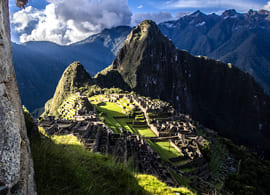
If your sights are set on the Incan citadel of Machu Picchu, you’ll continue with a domestic flight to Cusco, the main gateway for the Sacred Valley. From there, you’ll go on a memorable train ride to Aguas Calientes, the closest town to Machu Picchu. If you’re drawn to the Colca Canyon, you’ll fly on to the colonial city of Arequipa. And if the Peruvian Amazon is on your bucket list, you’ll fly to the Iquitos airport.
This kind of deliberate, step-by-step travel is one of the most underrated pleasures of Peru. It’s the kind of destination that rewards travelers who explore it in stages, building anticipation before delivering awe.

Preparing to Get to Peru: Do You Need a Visa?
Whether or not you need a visa for Peru depends on your nationality.
Visa and entry requirements vary by country, but travelers coming from the US and many Western European and Latin American countries do not require a visa for standard tourist stays. That means you can receive a visitor permit stamp for up to 90 days on arrival. You should still always confirm the current regulations before flying, as they are subject to change.

What Documents Should You Have Ready?
At minimum, most travelers should plan to bring their passport with at least six months of validity at the time of travel. Make sure to have your flight and itinerary details readily accessible in case of questions from immigration officers upon entering the country, as well as travel insurance and emergency contact information. These instructions and more are all outlined in our Peru packing checklists to make the logistics of the journey as smooth as possible.

Why Packing Matters More Than You Think
How you get to your Peru adventure determines how you should pack.
One of the realities of Peru travel is that many trips move across multiple elevations and regions. A journey might begin on the coast, continue into the Andes, and then extend into the Amazon, all of which have very different climates. You may need lightweight, sweat-wicking clothing for rainforest adventures and longer layers for forays into high-altitude mountain towns.

If your itinerary includes a visit to Machu Picchu, make sure you’re prepared to separate out a smaller piece of luggage or daypack, as both the train and entry to the archaeological site have strict size limits.
While these are important tips to keep in mind, with Quasar, you’ll be well-informed and guided so the burden isn’t on you to keep track of all the moving pieces. The journey will flow intuitively and effortlessly, so you can do the important job: focusing on the immersive experiences at hand and making precious memories with your travel companions.
How a Peru Journey Flows With Quasar
If you’re wondering how to get to Peru, your question may not just be about logistics, but also about ease. How stressful is it to piece together the journey from place to place? Will the experience be worth the effort?
Peru is very accessible, but it’s also a destination that works best when the journey is well choreographed. With Quasar’s 40 years of experience curating immersive South American adventures, we know how important it is to think of every detail so you don’t have to. There are a lot of steps to get from the main hub of Lima to Machu Picchu, the Sacred Valley, the Amazon, Arequipa, and beyond. But when you visit Peru the Quasar Way, you experience this as a beautifully paced progression rather than a logistical puzzle you have to solve.

Final Answer: How Do You Get to Peru?
For most travelers, you get to Peru by flying into Lima’s Jorge Chávez International Airport, the country’s main international gateway. From there, your trip may continue with a domestic flight to other parts of Peru depending on your itinerary.
One of the easiest misunderstandings is to think of Peru as a single-point destination.

Instead, it’s a country best understood piece by piece. Lima is your first encounter with Peru. From there, you’ll continue inland, deeper into other landscapes and ways of life. That is not a complication to stress about, but rather a key part of Peru’s richness. Coast, mountain, valley, and rainforest all belong to the same country, and that diversity contributes to how expansive the journey feels once you are in it.
Quasar’s Peru luxury tours embrace that truth rather than brushing over it. They are designed so Guests can feel the progression without being burdened by the mechanics of it all. The result is an unforgettable adventure that leaves you with a lasting impression of Peru’s rich culture, cuisine, and history, as well as the diversity of its landscapes. When done right, Peru isn’t just compelling…it’s absolutely magical.